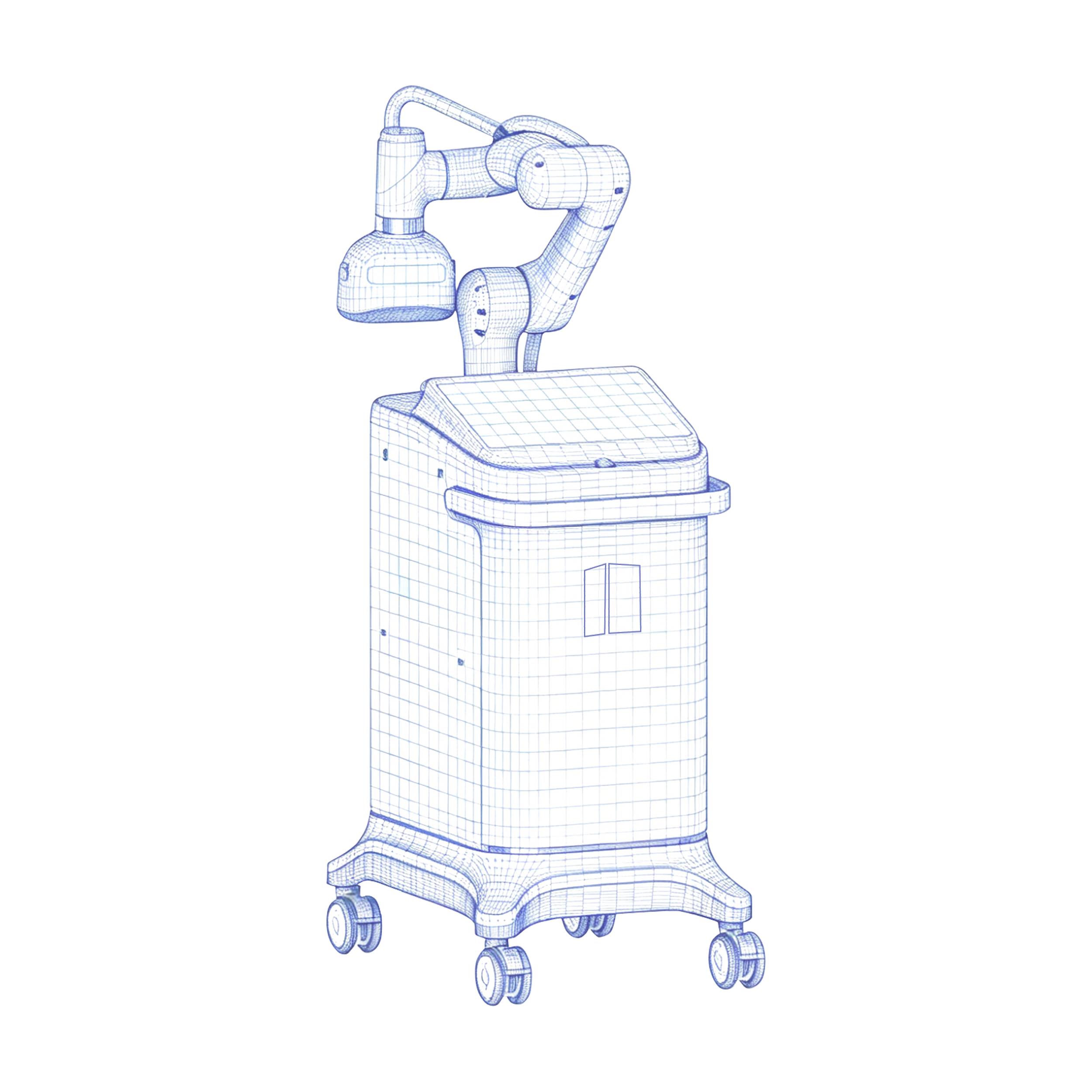
Our tFUS and TMS platforms share a common AI targeting engine and robotic delivery framework, designed from the ground up for precision, reproducibility, and translational research.
Enables personalized session planning based on each individual's neuroimaging data, supporting multi-modal imaging localization including MRI, fMRI, DTI, and PET-CT. Leveraging AI image segmentation technology, the engine achieves high-precision targeting—consistent with the 0.9mm system accuracy and 0.15mm execution repeatability of our platform—ensuring precise localization of functional nodes and structural pathways for personalized neuromodulation.
Automated robotic positioning eliminates operator variability, with full recording and reproducibility of all critical parameters (including pose, position, and angle of stimulation devices). It can complete contactless registration in just 15 seconds, further streamlining the workflow while ensuring every session is highly reproducible and every dataset is directly comparable across sessions, operators, and multi-site studies, laying a solid foundation for rigorous research and reliable clinical application.
Integrates specialized skull aberration correction technology to effectively overcome acoustic distortion, enabling non-invasive access to deep brain structures that standard non-invasive tools cannot reach. Additionally, computational modeling of individual tissue properties enables intelligent search for optimal poses, optimizing energy delivery efficiency, enhancing targeting accuracy, and minimizing off-target effects—greatly improving the safety and efficacy of neuromodulation for each individual.
Seamlessly compatible with a broad range of biosignal monitoring tools (e.g., EEG, eye-tracking, physiological sensors), supporting closed-loop research and clinical workflows within a single integrated system. This integration streamlines data collection and analysis, enables real-time adjustment of stimulation parameters based on biosignal feedback, and enhances the completeness and reliability of research and clinical data.
Transcranial focused ultrasound (tFUS) uses non-invasive acoustic energy to access deep brain structures—addressing a critical gap in neuroscience research, where standard non-invasive tools fail to reach these regions. Tailored to fit diverse research scales and settings, with channel options matching different research needs: a desktop research platform up to 256 channels, which can also be integrated with navigation and robotic arm for neuroscience research or clinical neuromodulation, and a 1024-channel version for ultra-precise focusing or multi-targets in advanced research exploration.
Interested in leveraging our tFUS platform for your neuroscience research? Let’s connect—we’ll walk you through our proprietary technology, demonstrate how it fits your specific research goals (preclinical/human, specific brain regions), and share case studies of labs using our system to advance their work.
Contact UsTranscranial magnetic stimulation uses focused magnetic fields to modulate cortical brain circuits without surgery or implants. Our AI-robotic TMS platform is built for research and clinical settings that demand consistent, reproducible, and personalized neuromodulation.
Interested in our TMS platform for your research or clinical program? Get in touch and we will walk you through the details.
Contact Us